
What Happens If Police Find Drug Manufacturing Equipment In Your Garage?
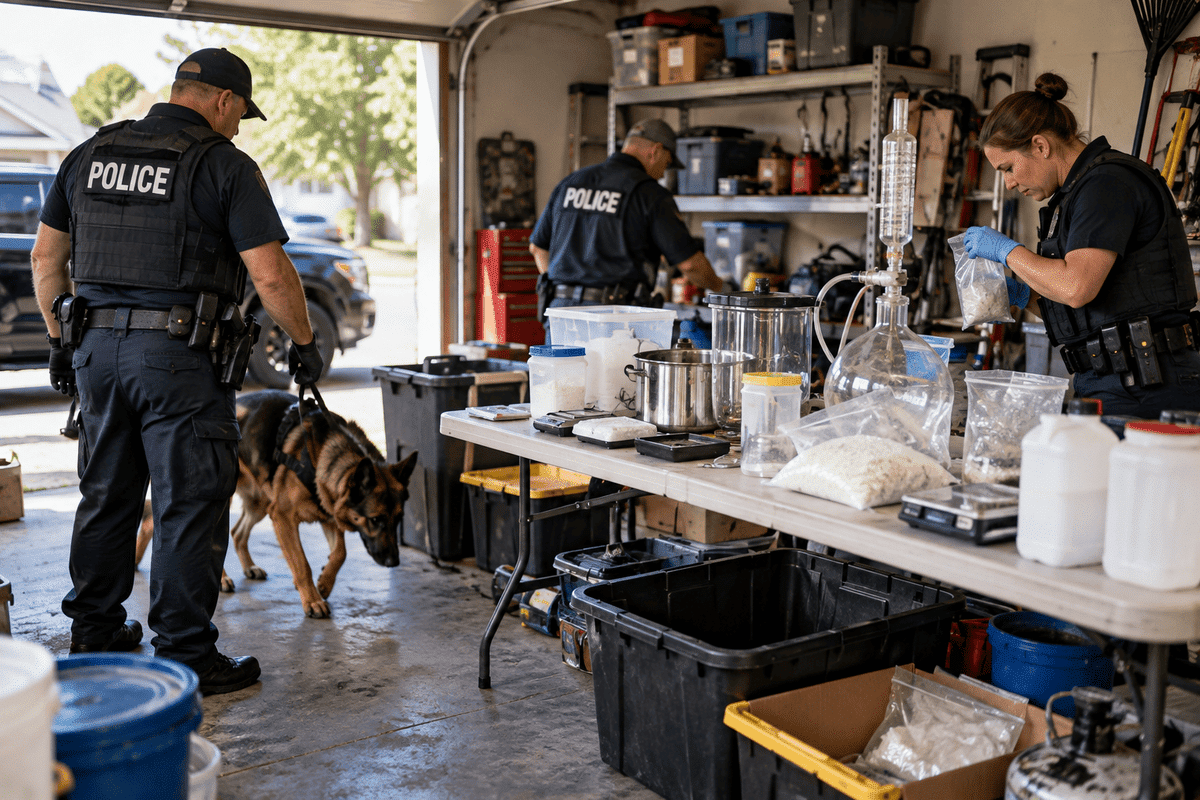
If police find chemicals, lab equipment, pill presses, scales, containers, or similar items in a Boulder garage, the situation can quickly become serious. Just having this equipment does not automatically mean someone made illegal drugs. Still, Colorado law lets prosecutors file charges if they believe the evidence shows an intent to manufacture a controlled substance. Police will often look at more than just the items in the garage. We look at who used the garage, why the equipment was there, what substances were present, whether there are signs of drug manufacturing, and if the police gathered the evidence legally before planning a defense.
Colorado Law Can Criminalize Possession Of Equipment With Intent To Manufacture Drugs
Colorado Revised Statutes § 18-18-405(1)(a) makes it unlawful to knowingly manufacture a controlled substance or possess a controlled substance with the intent to manufacture, dispense, sell, or distribute it. Importantly, the statute also covers possession of chemicals, supplies, or equipment with the intent to manufacture a controlled substance.
This last point is important. Finding regular lab equipment, glassware, containers, scales, tools, or chemicals does not automatically mean there is an illegal drug operation. Many of these items have legal uses. Prosecutors must show that the equipment and the situation prove criminal intent.
When we defend these cases, we focus on what the police actually found instead of just accepting their description of the garage as a drug lab.
Police Will Look For Evidence Showing What The Equipment Was Being Used For
Investigators often look at the whole scene to understand the equipment. Items that are legal on their own may seem more suspicious if police say they were found with drugs, chemicals used to make drugs, instructions, packaging, messages about drug production, or other evidence.
Police may send substances or residue to a lab for testing. Digital evidence can also matter. Investigators might check phones, computers, texts, photos, online accounts, or search histories if they think these records show knowledge or intent.
We do not assume that circumstantial evidence means what prosecutors claim. Every piece of evidence needs to be considered in context, and it is up to the prosecution to prove the crime beyond a reasonable doubt.
Methamphetamine Manufacturing Materials Can Create Additional Problems
Colorado has a statute specifically addressing certain materials associated with manufacturing methamphetamine and amphetamine. Under C.R.S. § 18-18-412.5, unlawful possession of materials to make methamphetamine or amphetamine can constitute a level 2 drug felony when the statutory requirements are satisfied. Colorado’s criminal classification materials identify a violation of this provision as a level 2 drug felony.
These cases can therefore expose a defendant to consequences far more serious than a simple paraphernalia allegation. The particular substances, quantities, equipment, alleged purpose, and surrounding evidence can all affect the charges.
We carefully distinguish between ownership of lawful household or commercial materials and evidence that allegedly demonstrates a criminal purpose.
Who Had Possession And Control Of The Garage?
One of the most important questions may be whether the accused person actually possessed or controlled what police found.
A garage can be used by several people. A spouse, roommate, relative, tenant, employee, previous resident, or other person may have access to the same area. The fact that police find an object on property associated with a defendant does not necessarily answer who possessed it or who knew it was there.
We may examine keys, access, ownership, fingerprints, DNA evidence, communications, surveillance footage, witness statements, receipts, leases, and other evidence that can help establish who actually controlled the area or the items.
This becomes especially important when prosecutors rely on constructive possession rather than evidence showing that the defendant physically possessed the suspected materials.
The Type And Amount Of Controlled Substance Can Affect The Charge
Drug-manufacturing charges under C.R.S. § 18-18-405 are classified in part according to the controlled substance and quantity involved. Depending on the facts, violations can range across different drug felony levels, while certain Schedule V violations can be classified as a level 1 drug misdemeanor.
Separate possession charges may also arise if police find finished drugs or controlled substances in the garage. C.R.S. § 18-18-403.5 governs unlawful possession of controlled substances, with classifications that depend on the drug, quantity, and circumstances.
This is why we review the laboratory results rather than relying solely on what an officer wrote in an arrest affidavit. The identity and weight of a substance can have a direct effect on charging and sentencing exposure.
Police Still Need A Lawful Basis To Search Your Garage
A garage attached to or associated with a home can receive significant Fourth Amendment protection. Police generally cannot simply enter a private garage and search it because they are curious about what is inside.
Depending on the circumstances, officers may rely on a search warrant, valid consent, an applicable warrant exception, or another lawful basis for entry. When a warrant was issued, we examine the affidavit supporting it and the scope of the warrant. When police claim someone consented, we examine who supposedly gave permission, whether that person had authority to do so, and whether officers remained within the scope of the consent.
If evidence resulted from an unconstitutional search or seizure, we may seek suppression of that evidence. Losing critical physical evidence can substantially affect the prosecution’s ability to prove a manufacturing charge.
Intent Can Become The Central Issue In The Defense
Possession of equipment and intent to manufacture drugs are not the same thing.
A defendant may lawfully possess tools, chemicals, glassware, heating equipment, scales, containers, or other items that police associate with drug production. The prosecution must establish the criminal mental state required by the statute.
We may challenge whether the equipment was actually intended for manufacturing, whether our client knew prohibited materials were present, whether someone else controlled the equipment, whether forensic testing supports the allegations, and whether investigators have interpreted innocent conduct as criminal activity.
A garage full of suspicious-looking objects can give police a theory. It does not relieve prosecutors of their obligation to prove the elements of the offense.
FAQs About Drug Manufacturing Equipment Found In A Colorado Garage
Can I Be Charged If Police Find Drug-Manufacturing Equipment But No Finished Drugs?
Potentially. C.R.S. § 18-18-405(1)(a) specifically addresses possession of chemicals, supplies, or equipment with the intent to manufacture a controlled substance. Prosecutors therefore do not necessarily need to prove that a finished batch of drugs existed before an investigation can lead to charges.
The absence of finished drugs can still be highly relevant. We would examine what equipment was found, whether any controlled substances or precursor materials were present, what forensic testing showed, and what evidence allegedly establishes intent. Ordinary equipment with legitimate uses presents a very different factual situation from an operating drug-production site.
What If The Equipment Belonged To Someone Else?
Ownership and possession are separate issues, and both can matter. If several people had access to the garage, prosecutors may have difficulty establishing who knew about particular items and who exercised control over them.
We investigate who used the garage, who purchased the equipment, whose property was stored nearby, whether the accused had exclusive access, and whether physical or digital evidence connects a particular person to the alleged manufacturing activity. Shared access can create significant factual questions that should not be overlooked.
What Happens If Police Find Methamphetamine-Making Materials?
Methamphetamine allegations require particularly careful attention because Colorado has a specific statute covering unlawful possession of materials used to manufacture methamphetamine and amphetamine. C.R.S. § 18-18-412.5 can result in a level 2 drug felony when its statutory elements are established.
We would review exactly what substances were seized, laboratory testing, quantities, how the materials were stored, and what evidence supposedly demonstrates their intended use. Police descriptions such as “meth lab” or “manufacturing materials” are allegations. The underlying evidence still has to support the criminal charge.
Can Police Search My Garage Without A Warrant?
Not automatically. Whether a warrantless garage search is constitutional depends heavily on the facts. Officers may claim consent, exigent circumstances, another recognized exception to the warrant requirement, or that the location searched did not carry the privacy protection claimed by the defense.
We examine how officers entered the property, what they knew beforehand, whether anyone gave consent, who provided that consent, where officers searched, and what they seized. If a search violated constitutional protections, a suppression motion may prevent illegally obtained evidence from being used against the defendant.
Could I Face Both Manufacturing And Possession Charges?
Yes, depending on what police find and how prosecutors interpret the evidence. C.R.S. § 18-18-405 addresses unlawful manufacturing and possession with intent to manufacture, distribute, dispense, or sell, while C.R.S. § 18-18-403.5 separately governs unlawful possession of controlled substances.
The charges depend on the substance, quantity, alleged conduct, and other facts. We analyze each count independently because prosecutors still must prove every required element. The existence of several charges in an information or complaint does not mean every charge is supported by sufficient evidence.
What Should I Do If Police Say They Found Drug-Manufacturing Equipment On My Property?
We generally advise against trying to explain suspicious equipment to investigators without first obtaining legal advice. Statements intended to clear up a misunderstanding can instead become evidence concerning knowledge, ownership, possession, or intent.
We can investigate the search, examine the warrant and supporting affidavit when applicable, review laboratory evidence, determine who had access to the property, and evaluate whether prosecutors can actually connect our client to an alleged manufacturing operation. Early defense work can also help preserve surveillance footage, communications, receipts, witnesses, and other evidence that may later become important.
Speak With A Boulder Criminal Defense Lawyer About Drug Manufacturing Allegations
When police claim that equipment found in a garage was intended for manufacturing controlled substances, we do not treat the officers’ theory as established fact. At Watkins Law Firm LLC, we examine the physical evidence, alleged controlled substances, laboratory testing, ownership and access to the property, evidence of intent, witness statements, digital evidence, and the legality of the police search.
Drug-manufacturing allegations can expose a defendant to serious felony charges and long-term consequences. A defense may focus on lack of knowledge, lack of intent, another person’s possession or control, insufficient forensic evidence, problems with the prosecution’s interpretation of the equipment, or an unlawful search and seizure.
If police found alleged drug-manufacturing equipment in your garage, home, vehicle, or other property, we can review what happened and discuss the defenses that may apply. Watkins Law Firm LLC represents clients in Boulder and throughout the Denver area from our office locations in Boulder, Colorado.
Contact our Boulder drug crime attorney by calling us 24/7 at (303) 507-1324 for your free consultation.
