
How Federal Prosecutors Use Phone Records, Texts, And Financial Records
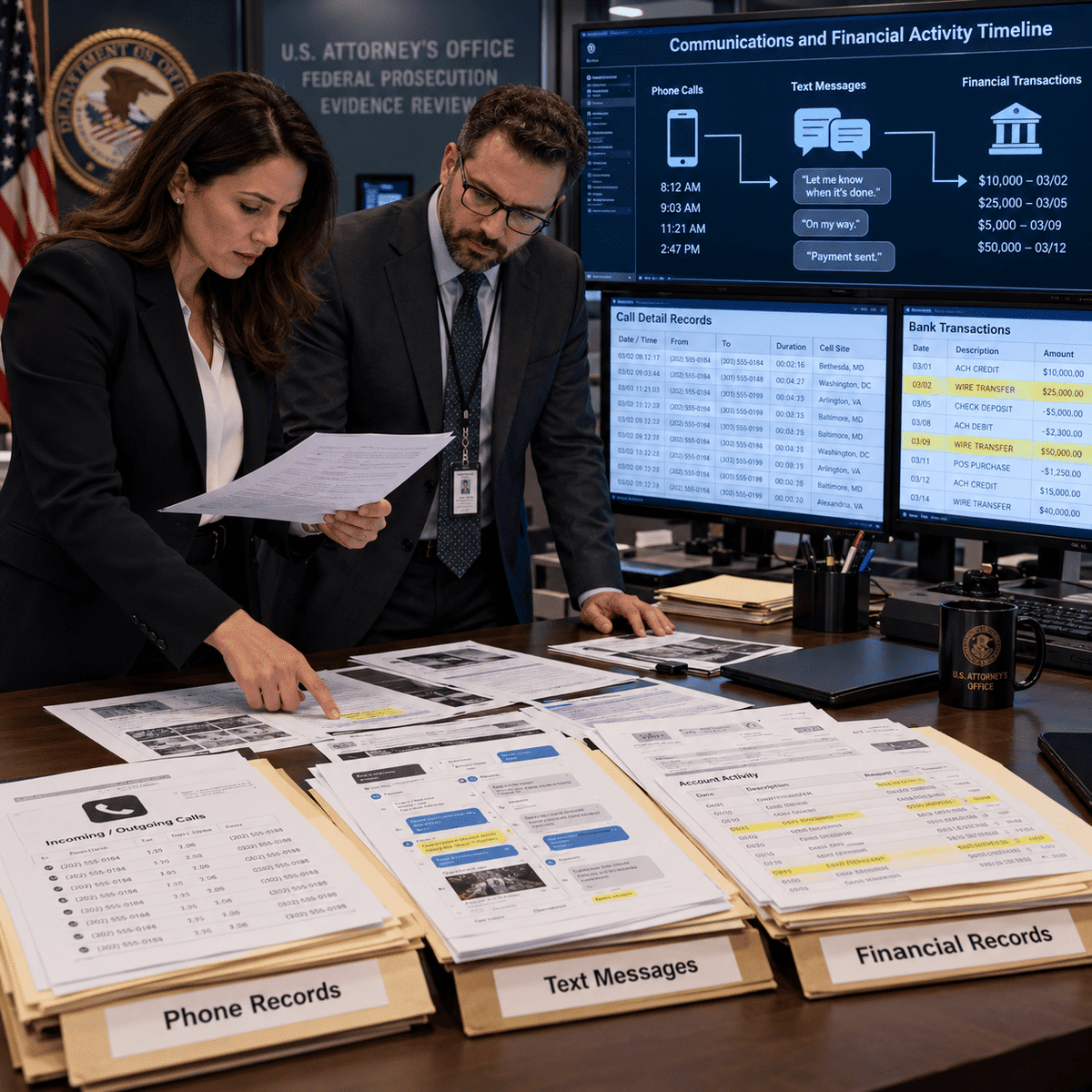
When federal investigators build a criminal case in Boulder, some of the most important evidence often does not come from eyewitnesses. Phone records, text messages, bank transactions, payment histories, location data, and other electronic records can help prosecutors piece together months or even years of someone’s activities. We often see how different types of digital evidence can be combined to show relationships, track financial transactions, create timelines, and question what a suspect has told investigators.
A text message that seems harmless on its own may look very different when compared with a bank transfer or phone record from the same day. If you find out that federal agents are looking at these records, it is important to realize that investigators may already have a lot of information before they ever contact you.
Federal Prosecutors Can Build A Timeline From Phone Records
Federal investigators may look at phone records to find out who talked to whom, when the calls happened, and how often certain numbers were in contact. Depending on what records they are allowed to get, investigators might also collect information about the account holder, connection times, session details, and other account data.
The Stored Communications Act, including 18 U.S.C. § 2703, establishes procedures through which the government may compel electronic communication providers to disclose certain communications and account records. The legal process required depends on the type of information sought. Section 2703 distinguishes between the contents of communications and non-content subscriber or transactional information. Federal law also permits the government to request that providers preserve records while investigators obtain appropriate legal process.
This kind of information can be especially important in conspiracy cases. Prosecutors may try to show that several people talked right before or after a transaction, meeting, money transfer, or other event. However, just because calls happened does not prove what was said. We pay close attention to this difference because simply being in contact with someone does not mean you were involved in a crime.
Text Messages Can Become Evidence Of Knowledge And Intent
Texts and electronic messages can give prosecutors something telephone logs generally cannot: the actual words attributed to the people involved.
Investigators may search a seized phone pursuant to appropriate legal authority or obtain stored electronic information through legal process directed to a service provider. Under 18 U.S.C. § 2703, warrants and other statutory procedures govern government access to different categories of stored communications and records.
Prosecutors often focus on messages they think show intent, knowledge, planning, ownership, or involvement in a crime. They may compare these messages with photos, financial transactions, travel records, surveillance, and witness statements.
Context matters. A prosecutor may characterize a short message as evidence of an illegal agreement while the surrounding conversation supports another explanation. We therefore want to examine complete conversations rather than isolated screenshots or selected excerpts whenever the evidence permits us to do so.
Live Interception Is Different From Obtaining Stored Messages
There is an important legal distinction between obtaining communications that already exist and intercepting communications while they are occurring.
Federal wiretap procedures are governed principally by Title III of the Omnibus Crime Control and Safe Streets Act, including 18 U.S.C. § 2518. A federal wiretap application must satisfy substantial statutory requirements. Among other things, the application must identify the offense under investigation, describe the communications sought, and provide facts supporting the requested interception. The statute also generally requires a showing concerning why ordinary investigative techniques have failed, reasonably appear unlikely to succeed, or would be too dangerous.
Wiretap orders are also subject to time limitations and minimization requirements intended to restrict interception of communications outside the authorized investigation. Federal law provides procedures for challenging unlawfully intercepted communications under specified circumstances.
These requirements can become important defense issues when intercepted communications form a significant part of the prosecution’s case.
Financial Records Can Show Where Money Came From And Where It Went
Financial evidence can be especially significant in federal fraud, drug trafficking, money laundering, conspiracy, tax, and other financially motivated investigations.
Investigators may examine deposits, withdrawals, wire transfers, checks, credit card transactions, payment applications, account ownership, and transfers between individuals or businesses. Prosecutors can then compare those transactions against communications and other evidence.
The Right to Financial Privacy Act regulates federal government access to certain customer financial records. Under 12 U.S.C. § 3402, federal authorities may obtain qualifying financial records through authorized mechanisms that can include administrative process, search warrants, judicial subpoenas, and formal written requests, subject to statutory requirements and exceptions.
A federal search warrant for covered financial records must comply with applicable Federal Rules of Criminal Procedure requirements under 12 U.S.C. § 3406. Judicial subpoenas are separately addressed by 12 U.S.C. § 3407.
Prosecutors Often Combine Digital And Financial Evidence
The real power of these records frequently comes from combining them.
Suppose investigators identify repeated communications between two people. Bank records then show a transfer shortly after those communications. Location or other evidence places the individuals together around the same period. Additional messages appear to discuss a transaction.
Prosecutors may argue that the combined evidence establishes an agreement, intent, or participation in criminal activity.
We do not assume that the government’s interpretation is the only reasonable interpretation. Timing alone does not necessarily prove causation, and a financial transfer can have an innocent explanation. Communications between friends, relatives, employees, or business associates may be completely legitimate even when they occur near an event investigators consider suspicious.
The Same Records May Create Colorado Criminal Exposure
A federal investigation does not necessarily prevent Colorado authorities from examining conduct that potentially violates state law.
For example, financial and electronic evidence may be relevant to allegations involving theft under C.R.S. § 18-4-401, forgery under C.R.S. § 18-5-102, or identity theft under C.R.S. § 18-5-902. Colorado’s forgery statute addresses specified conduct involving falsely making, completing, altering, or uttering certain written instruments with intent to defraud.
Complex investigations may also involve allegations under the Colorado Organized Crime Control Act. C.R.S. § 18-17-104 prohibits specified conduct involving patterns of racketeering activity, enterprises, unlawful debt, and related conspiracies. Electronic communications and financial records can become important evidence when prosecutors attempt to establish relationships between alleged participants and transactions associated with an alleged enterprise.
This is why we examine both federal and Colorado exposure when the underlying conduct could implicate both systems.
Challenging The Government’s Interpretation Of Electronic Evidence
Digital records can appear objective, but the conclusions prosecutors draw from them are not necessarily beyond dispute.
We may examine whether evidence was lawfully obtained, whether a warrant was sufficiently supported and appropriately limited, whether investigators complied with applicable statutory requirements, whether the records actually belong to the accused, and whether prosecutors are presenting communications in their proper context.
Authentication can matter as well. The fact that a message appears on a device does not automatically resolve every question concerning who wrote it, who controlled the account, or what the participants intended.
Financial evidence raises similar issues. A transfer establishes that money moved between accounts. It does not, standing alone, necessarily establish why the transfer occurred.
Why Early Legal Representation Matters In A Federal Investigation
Federal investigations can develop quietly. Investigators may collect records from third parties long before the target realizes an investigation exists.
By the time agents execute a search warrant, serve a grand jury subpoena, or request an interview, investigators may already have assembled telephone records, electronic communications, financial transactions, and information from witnesses.
We believe this makes early legal representation especially important. Statements made during an interview can be compared immediately against records investigators already possess. Before speaking with federal agents or making decisions about a subpoena or investigation, we can assess the situation, determine what legal issues may exist, and protect our client’s rights throughout the process.
Frequently Asked Questions About Federal Phone, Text, And Financial Evidence
Can Federal Prosecutors Obtain My Text Messages?
Federal authorities can obtain certain stored communications when they satisfy the applicable legal requirements. The Stored Communications Act, including 18 U.S.C. § 2703, establishes different procedures for obtaining communication content and non-content account information. Investigators may also obtain evidence directly from a device seized pursuant to lawful authority.
We examine exactly how the government acquired the messages because the source can affect the legal analysis. Messages extracted from a phone, records obtained from a provider, screenshots supplied by another person, and intercepted communications can raise different issues. We also examine whether the complete conversation changes the meaning prosecutors assign to selected messages.
Can Federal Investigators Obtain My Bank Records Without Asking Me?
Under federal law, government investigators have several mechanisms for obtaining qualifying financial records. The Right to Financial Privacy Act, including 12 U.S.C. § 3402, establishes procedures and exceptions governing government access to covered customer financial information. Depending on the circumstances, records may be obtained through a search warrant, judicial subpoena, administrative process, or another legally authorized method.
Notice rules also depend on the process used and applicable statutory provisions. A person therefore should not assume that the absence of prior contact from investigators means financial records have not been sought.
Does A Phone Call Between Two Suspects Prove A Conspiracy?
No. A telephone record can show evidence of contact, but the existence of a call ordinarily does not establish what was discussed or why the communication occurred.
Prosecutors may attempt to strengthen their interpretation by comparing the call with texts, financial transactions, surveillance, witness statements, or other events. We examine whether those connections actually support the government’s theory or whether legitimate explanations exist. People communicate for countless lawful personal and business reasons. The prosecution still has to prove the required elements of the charged federal offense beyond a reasonable doubt.
Can Prosecutors Use Deleted Text Messages?
Potentially. Deleting a message from a device does not necessarily mean every copy or record associated with that communication has disappeared. Another participant may retain the message, information may exist on another synchronized device, or investigators may obtain relevant information from another lawful source.
If deleted communications become evidence, we examine how they were recovered, whether the evidence is complete, whether it can be properly attributed to the accused, and whether investigators obtained it lawfully. We also caution clients against deleting or altering potential evidence after learning of an investigation because destruction or concealment of evidence can create serious additional legal problems.
What Should We Do If Federal Agents Ask To Discuss Phone Or Financial Records?
We recommend obtaining legal advice before agreeing to a substantive interview. Investigators may already possess records that the person being questioned has never seen. Their questions may be designed to compare the person’s answers with evidence collected over an extended investigation.
We can communicate with investigators, determine what information can appropriately be learned about the investigation, assess potential federal and Colorado exposure, and advise our client before decisions are made about interviews, subpoenas, searches, or document requests. Early representation can be particularly important because statements to federal investigators may become evidence themselves.
Speak With A Boulder Criminal Defense Lawyer About A Federal Investigation
When federal prosecutors are examining phone records, text messages, financial transactions, or other electronic evidence, we know that the investigation may be much further along than it first appears. At Watkins Law Firm LLC, we examine how the government obtained the evidence, what the records actually establish, whether important context is missing, and whether constitutional or statutory issues affect the government’s ability to use that evidence.
We represent clients in Boulder and throughout the Denver area from our office locations in Boulder, Colorado. If you are under federal investigation, have received a subpoena, have been contacted by federal agents, or have been charged with a federal offense, we encourage you to obtain legal advice before making statements or providing information to investigators.
Contact our Boulder DUI defense attorney by calling us 24/7 at 303-507-1324 for your free consultation. We can review the circumstances surrounding the investigation, discuss the phone, text, financial, or electronic evidence involved, and explain the legal issues that may affect your defense.
