
Can You Be Charged With Assaulting a Police Officer in Colorado for Resisting Being Handcuffed?
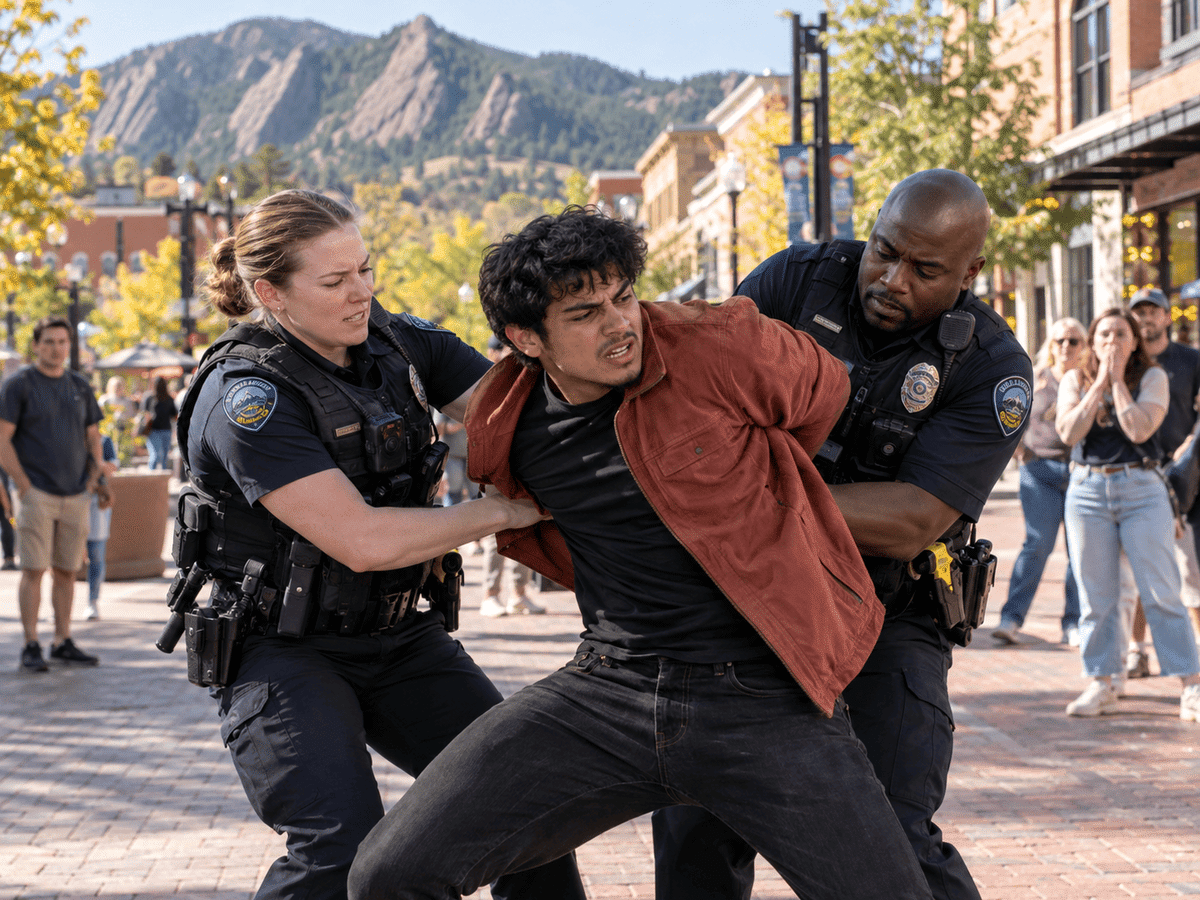
Being arrested in Colorado can quickly become a frightening and confusing experience, particularly when police officers attempt to place you in handcuffs. Some people instinctively pull their arms away, tense their bodies, or question an officer’s actions without intending to hurt anyone. Unfortunately, what begins as a routine arrest can result in additional criminal charges if officers believe someone intentionally resisted or used physical force against them.
Under Colorado law, certain actions during handcuffing may support charges of resisting arrest, while more serious conduct can lead to felony assault charges. At Watkins Law Firm LLC, we understand how quickly these situations can escalate, and we help individuals in Boulder and throughout the Denver area defend themselves against allegations involving police officers. We examine the circumstances of the arrest, the officer’s actions, and the available evidence to determine whether the prosecution can establish every element of the alleged offense.
Resisting Handcuffing Is Not Automatically Assault in Colorado
Colorado law makes a clear difference between resisting arrest and assaulting a police officer. While both charges can come from the same incident, each one requires proof of different actions and intentions.
Under Colorado Revised Statutes § 18-8-103, resisting arrest generally occurs when someone knowingly prevents or attempts to prevent a peace officer from making an arrest by using or threatening physical force or violence against the officer or another person, or by using other means that create a substantial risk of bodily injury.
Resisting arrest is a class 2 misdemeanor in Colorado. But not every movement or refusal to cooperate meets the legal definition.
Third-Degree Assault Against a Police Officer Under Colorado Law
A serious outcome of a struggle during handcuffing can be a charge of third-degree assault against a police officer.
Under C.R.S. § 18-3-204, third-degree assault generally involves knowingly or recklessly causing bodily injury to another person or negligently causing bodily injury with a deadly weapon.
The statute also addresses conduct involving peace officers and certain other protected personnel, including intentionally causing them to come into contact with specified bodily fluids or substances under circumstances described by law.
It’s important to know that third-degree assault is not always a felony just because the alleged victim is a police officer.
We examine the precise statutory subsection, the alleged injuries, and the officer’s account before determining which charges the evidence may support.
An officer’s allegation that someone resisted handcuffing is not, by itself, proof that an assault occurred.
Second-Degree Assault for Injuring a Police Officer
Colorado law provides particularly serious penalties when someone intentionally causes bodily injury to a peace officer performing official duties.
Under C.R.S. § 18-3-203(1)(c), a person may commit second-degree assault when, with intent to prevent a peace officer from performing a lawful duty, the person intentionally causes bodily injury to the officer.
This offense is generally classified as a class 4 felony under § 18-3-203(2)(c), subject to applicable statutory exceptions and sentencing provisions.
Consider an arrest in which someone forcefully strikes an officer while attempting to escape being handcuffed. If prosecutors can establish the required intent, injury, and lawful-duty elements, the conduct may support a second-degree assault charge.
However, an accidental collision or an involuntary reaction does not automatically establish the intentional conduct required by this provision.
We investigate whether the injury occurred because of an intentional act, an officer’s own movements, or the physical circumstances of the arrest.
Accidental Contact During Handcuffing
Physical contact between officers and suspects is common during arrests. Officers frequently hold someone’s wrists, reposition their arms, or apply pressure to secure handcuffs.
These actions can produce unexpected movements, particularly when someone experiences pain, loses balance, or reacts instinctively.
For example, an individual might suddenly move an arm because an officer twists it into an uncomfortable position. If the movement accidentally strikes the officer, prosecutors must still prove the elements of the particular assault charge.
We distinguish between intentional violence, reckless conduct, and accidental physical contact.
Body-camera recordings, witness statements, medical records, and the sequence of movements can become particularly important when determining what actually happened.
Assault Charges When an Officer Uses Excessive Force
Colorado law recognizes limited circumstances in which individuals may defend themselves against unlawful physical force.
Under C.R.S. § 18-1-704, a person may be justified in using physical force to defend themselves or another person when they reasonably believe such force is necessary to protect against the imminent use of unlawful physical force, subject to statutory restrictions.
However, C.R.S. § 18-1-704(2)(a) generally prohibits claiming self-defense to justify physical force used against a peace officer who is performing official duties, even when the arrest is unlawful, unless the officer uses or attempts to use excessive force.
This distinction is critical.
Someone generally cannot physically resist an arrest simply because they believe the officer lacks probable cause. However, an officer’s excessive force may raise a legitimate self-defense issue.
We carefully examine whether the officer’s conduct exceeded what was reasonably necessary and whether the accused person’s response was proportionate to the threatened harm.
Criminal Penalties for Resisting Arrest and Assaulting an Officer
The consequences of an arrest-related confrontation depend on the charges, the alleged injuries, and the defendant’s criminal history.
Under C.R.S. § 18-1.3-501, a class 2 misdemeanor generally carries up to 120 days in jail and a fine of up to $750.
Third-degree assault is ordinarily a class 1 misdemeanor, but it is also designated an extraordinary-risk crime under C.R.S. § 18-1.3-501(3), which can affect the applicable sentencing range.
Second-degree assault involving a peace officer under § 18-3-203(1)© is generally a class 4 felony. The applicable sentencing range can be significantly more severe, particularly when mandatory sentencing provisions or aggravating circumstances apply.
A felony conviction can also affect employment opportunities, professional licensing, firearm rights, and other important aspects of someone’s life.
We evaluate the specific charges and sentencing provisions rather than assuming every confrontation with an officer carries the same consequences.
Defending Against Allegations of Assault During Handcuffing
A strong criminal defense begins with examining the evidence rather than accepting the arrest report as a complete account of the incident.
We review body-camera footage, patrol-car recordings, witness accounts, photographs, medical documentation, and communications between responding officers.
We also investigate whether the officer was performing a lawful duty, whether the alleged injury can be established, and whether prosecutors can prove the required mental state.
In some cases, footage may reveal that the accused person was attempting to comply but could not physically position their arms as directed. Other cases may involve contradictory officer statements or injuries that occurred during a struggle without intentional violence.
We may also challenge evidence obtained through unconstitutional police conduct when a legally supported suppression motion is appropriate.
Our objective is to identify weaknesses in the prosecution’s case and pursue the most favorable available resolution, whether that involves dismissal, reduced charges, negotiations, or trial.
Frequently Asked Questions About Assaulting a Police Officer in Colorado
Can I Be Charged With Assault for Pulling My Arm Away While Being Handcuffed?
Yes, depending on the circumstances, prosecutors may file an assault charge if they believe your actions satisfy the elements of a Colorado assault statute. However, simply pulling your arm away does not automatically establish assault.
We examine whether the movement caused bodily injury, whether it was intentional or reckless, and whether the evidence supports the particular charge. A reflexive movement caused by pain or surprise may present a substantially different legal situation from deliberately striking an officer.
We also investigate whether the officer interpreted an attempt to regain balance or relieve pressure as deliberate resistance. Body-camera footage can be especially important when the officer’s description differs from what actually occurred.
Can I Be Charged With Both Resisting Arrest and Assaulting a Police Officer?
Yes. Colorado prosecutors may charge both resisting arrest under C.R.S. § 18-8-103 and assault under the applicable provisions of Title 18, Article 3, when the alleged conduct supports both offenses.
The charges involve different statutory elements. Resisting arrest concerns knowingly preventing or attempting to prevent an arrest through prohibited conduct, while assault charges generally focus on the required injury, physical contact, and mental state.
We examine whether the evidence independently supports each charge. We also consider whether Colorado’s rules concerning multiple convictions and merger limit the convictions or sentences that may ultimately be imposed.
What Happens If I Accidentally Injure an Officer During an Arrest?
An accidental injury does not automatically establish criminal assault. The prosecution must prove the mental state and other elements required by the charged offense.
For example, second-degree assault under C.R.S. § 18-3-203(1)© requires intentional bodily injury and the intent to prevent an officer from performing a lawful duty. An accidental injury alone would not establish those requirements.
However, some assault provisions also address reckless or criminally negligent conduct under specified circumstances. We therefore examine the exact charge rather than assuming that an absence of intent defeats every possible allegation.
Can I Defend Myself If a Colorado Police Officer Uses Excessive Force?
Colorado law recognizes a limited self-defense exception when a peace officer uses or attempts to use excessive force.
Under C.R.S. § 18-1-704(2)(a), the ordinary restriction against using physical force to resist an officer performing official duties does not apply in the same way when excessive force is involved.
That does not authorize unlimited physical resistance. We must examine whether the force was excessive, whether the response was reasonably necessary, and whether the amount of force used was justified.
Medical records, witness statements, body-camera footage, and photographs of injuries may help establish what occurred.
Can I Be Charged With Assault If the Police Officer Was Not Injured?
Yes, certain assault offenses do not require proof of a conventional physical injury. For example, Colorado’s third-degree assault statute includes specific provisions involving intentional contact with certain bodily fluids or substances.
However, the second-degree assault provision under C.R.S. § 18-3-203(1)© requires bodily injury. Without evidence establishing that element, a conviction under that particular provision would not be supported.
We evaluate whether the prosecution has evidence of legally sufficient injury or contact and whether another offense, such as resisting arrest, is more consistent with the alleged conduct.
Does an Illegal Arrest Give Me the Right to Resist Handcuffing?
Generally, no. Colorado does not provide an unrestricted right to use physical force against an officer simply because an arrest is unlawful.
Under C.R.S. § 18-8-103, it is generally not a defense to resisting arrest that the officer was attempting an unlawful arrest while acting under color of official authority, subject to the statute’s requirements and defenses.
We may challenge an unlawful arrest through appropriate court proceedings, including suppression motions when applicable. If the officer used excessive force, separate legal issues involving self-defense may also arise.
Can Body-Camera Footage Help Get Assault Charges Dismissed?
Yes. Body-camera footage may provide evidence that contradicts allegations of intentional assault or resistance.
We examine whether recordings show the accused person following instructions, reacting to pain, losing balance, or being subjected to force before the alleged assault occurred.
Video may also reveal inconsistencies between an officer’s written report and the actual sequence of events. However, recordings sometimes have obstructed views or incomplete audio, so we evaluate them alongside other evidence.
Favorable footage can support negotiations, motions, or trial defenses, although it does not guarantee dismissal.
Will I Go to Prison for Assaulting a Police Officer in Colorado?
A prison sentence is possible for certain felony assault convictions, but the outcome depends on the offense, applicable sentencing provisions, criminal history, and circumstances of the case.
Second-degree assault involving intentional injury to a peace officer performing a lawful duty is particularly serious and may carry mandatory sentencing consequences.
We examine the applicable felony classification, potential sentencing enhancements, and any legally available alternatives. We also assess whether the evidence supports a lesser charge or whether grounds exist to contest the prosecution entirely.
Boulder Criminal Defense Lawyer for Assault on a Police Officer Charges
Being accused of assaulting a police officer can place your freedom, employment, and future at risk. These cases often arise from fast-moving encounters in which the accused person and the officer have very different accounts of what happened. A police report may describe deliberate resistance even when the physical movements resulted from confusion, pain, or an attempt to comply with conflicting commands.
At Watkins Law Firm LLC, we defend individuals facing allegations of resisting arrest, third-degree assault, second-degree assault, and other criminal offenses arising from encounters with law enforcement. We carefully review the evidence, investigate the legality of the officer’s actions, and identify defenses supported by Colorado law.
We represent clients in Boulder and throughout the Denver metropolitan area from our office in Boulder, Colorado. Whether you are facing misdemeanor allegations or felony assault charges, we work to protect your constitutional rights and pursue the strongest available defense.
If you have been arrested for allegedly assaulting a police officer while resisting handcuffing, contact Watkins Law Firm LLC before discussing the incident with investigators. Statements made after an arrest can become important evidence, and understanding your legal rights early can help you avoid decisions that may damage your defense. Contact our Boulder assault defense lawyer by calling us 24/7 at 303-507-1324 for your free consultation.
