
Can Text Messages Be Used to Prove or Disprove Domestic Violence Charges in Colorado?
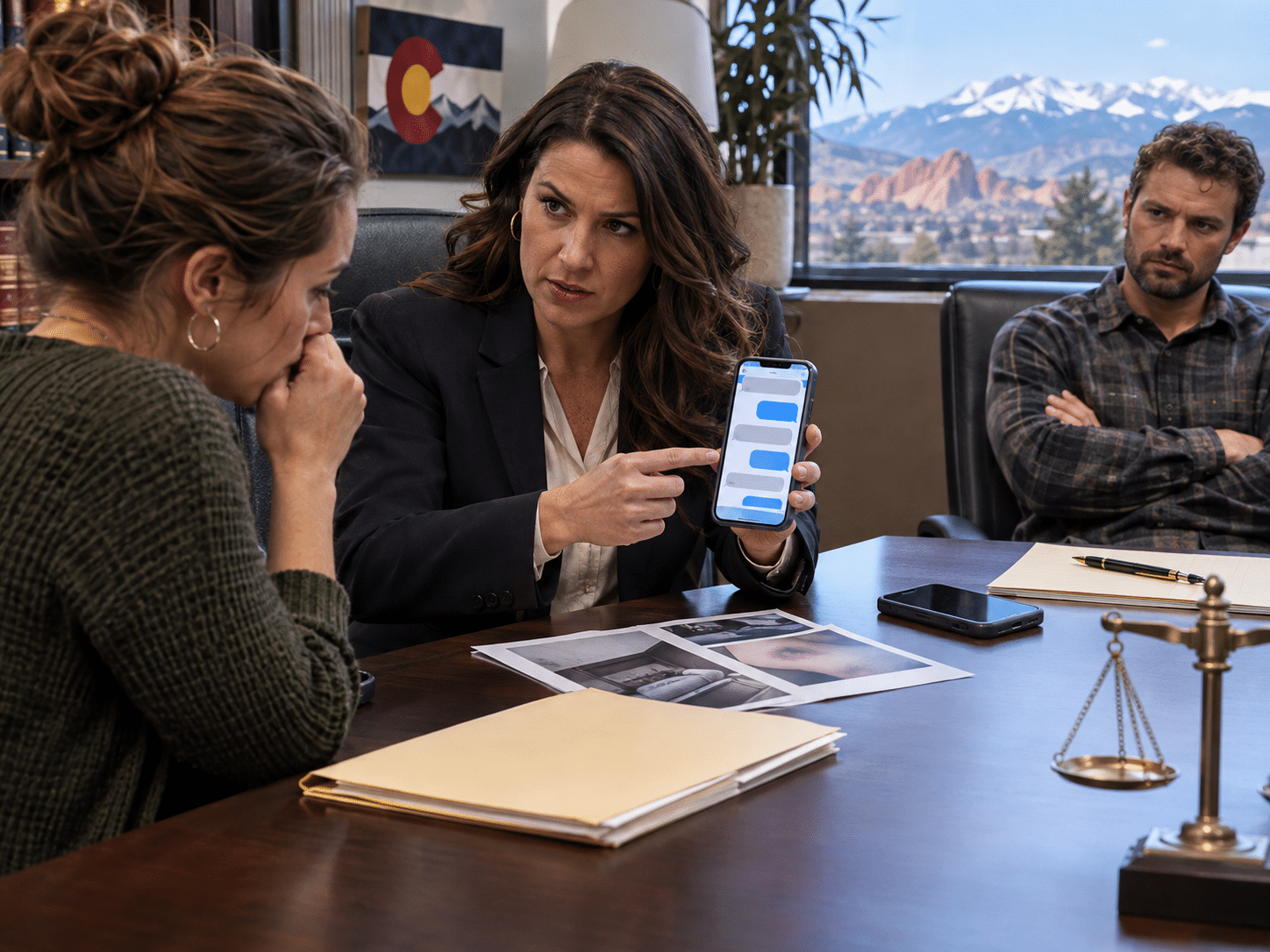
Texts are often a huge factor in Boulder domestic violence cases, particularly where the various parties involved have given conflicting accounts of what transpired. Texts sent hours, days or even weeks prior to the arrest can be used by the prosecutor to demonstrate threats, intimidation, harassment, or a pattern of control. They can also be used to show that the accuser’s story is inconsistent, to support a self-defense claim, or to show that the incident didn’t occur as the accuser describes. Of course, the communication between partners can be very emotional, and a single text can be very misleading in isolation. When we’re defending against a domestic violence charge in Boulder or the Denver area, we will look very closely at the electronic communications to see if they support or undermine the prosecution’s case.
How Colorado Domestic Violence Laws Apply to Text Messages
Colorado Revised Statutes § 18-6-800.3 defines domestic violence as an act or threatened act of violence against a person with whom the accused has or previously had an intimate relationship. It also includes certain crimes against a person or property which are committed as a means of coercion, control, punishment, intimidation or revenge. Unlike many other crimes, domestic violence is generally a label which is attached to an underlying crime rather than an offense in itself.
Text messages can help prosecutors show the relationship between people and what happened around an alleged crime. Messages with threats, admissions, repeated unwanted contact, or efforts to control someone else can become important evidence. Still, we understand that arguing over text does not automatically mean a crime was committed, even if the messages are angry or offensive.
How Prosecutors Use Text Messages To Support Domestic Violence Charges
Prosecutors may use the text messages to demonstrate what the defendant was thinking, feeling and doing prior to and following the incident in question. A message which contains a threat of physical harm could be used to support a charge of menacing or harassment (depending on the content of the message and the circumstances). A message sent after the incident may be used as evidence if it contains an admission, an apology for a particular action or an attempt to influence what the accuser says.
A prosecutor may also look at the timing and frequency of the messages. If someone is sending messages after having been told to stop, that could be evidence of harassment (in the right circumstances). We’ll look at whether the messages actually amount to harassment or whether the prosecutor is simply making out that the full conversation amounts to harassment.
Text Messages That May Help Disprove Domestic Violence Allegations
Electronic messages can be key evidence for the defense in the event of a dispute as to what actually happened. They can demonstrate that the accuser had previously described the incident in a different way, that they made statements which are inconsistent with the police report, or indeed that they have admitted facts which support the defense. Messages with time stamps can also be used to establish where someone was at a particular time and whether the events as reported are plausible.
We look at whole conversations instead of just single screenshots. A message that seems threatening at first might mean something different when you see earlier messages, later replies, and the history between the people involved. Still, even friendly messages sent after an alleged incident do not automatically prove that no assault happened, so we consider them along with other evidence.
Authentication And Admissibility Of Text Message Evidence
Before electronic communications can be admitted into evidence the party seeking to introduce them will generally be required to establish some basis for authentication under Colorado Rule of Evidence 901. This could involve the production of the sender’s telephone number, the presence of identifiable language, the existence of corresponding responses, or some other form of corroborating evidence to establish authorship. Simply having a name next to a message is not in itself sufficient to prove that that person authored it.
We also look at whether the messages have been altered, deleted or have simply been viewed without the relevant context. A screenshot may omit the earlier part of a conversation, and a forensic analysis can sometimes provide more detail around the message history and authenticity. Messages may be proved to be genuine but still be challenged in court on grounds of hearsay, relevance or unfair prejudice.
Criminal Charges And Penalties Associated With Domestic Violence Text Messages
Domestic violence allegations may involve third-degree assault, harassment, menacing, stalking, or other offenses. Under Colorado Revised Statutes § 18-3-204, third-degree assault is generally a class 1 misdemeanor. The ordinary sentencing range for a class 1 misdemeanor is up to 364 days in jail, a fine of up to $1,000, or both, although sentencing exceptions may apply. More serious assault charges can result in felony convictions and substantial prison sentences.
A domestic violence label can bring extra consequences beyond the main sentence. If someone is convicted, they usually have to go through a domestic violence evaluation and treatment, and some convictions can lead to restrictions on owning firearms. We also look at how a conviction might affect jobs, professional licenses, family court cases, and the person’s criminal record.
Text Messages And Violations Of Colorado Protection Orders
Text messages can create an additional criminal problem when a court has prohibited contact between the parties. Under Colorado Revised Statutes § 18-6-803.5, knowingly violating an applicable protection order may constitute a criminal offense. Depending on the circumstances, violations are classified as class 1 or class 2 misdemeanors, with class 1 classification applying to violations of mandatory criminal protection orders and certain other qualifying orders.
Even a seemingly harmless message may violate a no-contact provision. The protected person’s willingness to communicate generally does not authorize the restrained individual to disregard the court’s restrictions. We advise clients to comply strictly with existing orders and seek appropriate judicial modifications rather than relying on informal permission.
Preserving Text Messages And Building A Criminal Defense
It is very important to keep electronic evidence when text messages could affect a domestic violence case. Deleting messages, getting a new device, or changing screenshots can make defending the case harder and raise questions about evidence handling. We suggest keeping full message histories, important dates, and related communications whenever you can.
When we build a defense, we look at messages along with police reports, witness statements, medical records, surveillance video, and other electronic records. We search for inconsistencies, assumptions that are not backed up, and evidence that could create reasonable doubt. Sometimes, a well-documented message history gives a clearer picture of what happened than either person’s first statement to the police.
Frequently Asked Questions About Text Messages and Colorado Domestic Violence Charges
Can Deleted Text Messages Be Recovered And Used In A Domestic Violence Case?
Sometimes deleted messages can be recovered using forensic analysis, device backups, synced accounts, or records from other devices. Whether recovery is possible depends on the technology, how data is stored, and if the original information is still available. Wireless carriers usually do not keep full copies of regular SMS messages for long. We check if investigators got the messages legally and if the records can be proven real. We also recommend keeping any electronic evidence you have, since deleting important messages can cause serious legal problems.
Can Text Messages Prove That A Domestic Violence Accuser Is Making False Allegations?
Text messages can reveal differences between what an accuser says now and what they said before about the incident. For example, messages might show a different timeline, challenge a claimed threat, or include statements that tell another version of what happened. Still, just because messages are inconsistent does not always mean someone is lying on purpose. We compare messages with police reports, recordings, witness statements, and other evidence. If there are big contradictions, they can help with defense arguments like impeachment or raising reasonable doubt.
Can An Apology By Text Message Be Used As Evidence Of Domestic Violence?
Prosecutors might try to use apology messages as proof that the accused admitted to doing something wrong. But saying sorry does not always mean an assault or crime happened. A person might apologize for yelling, arguing, or upsetting someone without admitting to a crime. We look closely at the exact words and the rest of the conversation before deciding if a message is really an admission. We also check if the prosecution is reading too much into a statement that could mean something else.
Can I Text The Alleged Victim If They Contact Me First?
If a criminal protection order says you cannot communicate, replying to a message from the protected person can still break the order. Usually, the protected person cannot allow contact just by starting a conversation. It is best not to respond in ways that violate the order, save any messages you receive, and talk to a lawyer about what contact is allowed. If you need to communicate about parenting, money, or property, you may need to ask the court to change the order. Breaking the order can lead to more criminal charges, even if your original case is still open.
Protect Your Rights When Text Messages Become Evidence in a Colorado Domestic Violence Case
Text messages can influence how prosecutors evaluate domestic violence allegations, particularly when accusations depend on conflicting accounts of a relationship dispute. At Watkins Law Firm LLC, we recognize that electronic communications must be evaluated in their proper context before conclusions are drawn about someone’s conduct or criminal responsibility. We carefully examine message histories, police reports, alleged threats, and other available evidence to identify weaknesses in the prosecution’s case and determine which defenses may apply.
Our Boulder criminal defense law firm helps people accused of domestic violence, assault, harassment, breaking protection orders, and other crimes in Boulder and the Denver area. We know a domestic violence conviction can lead to jail time, required treatment, losing gun rights, and harm to your personal and work life. We focus on protecting your rights and building a defense based on the facts and Colorado law.
Contact our Boulder domestic violence defense attorney by calling us 24/7 at 303-507-1324 for your free consultation. Our Boulder office serves clients in Boulder and the Denver area who need legal help after a domestic violence arrest or criminal investigation. We will look at your situation, talk about how text messages might affect your case, and explain your defense options.
