
Can Police Frisk Me Every Time They Conduct A Terry Stop?
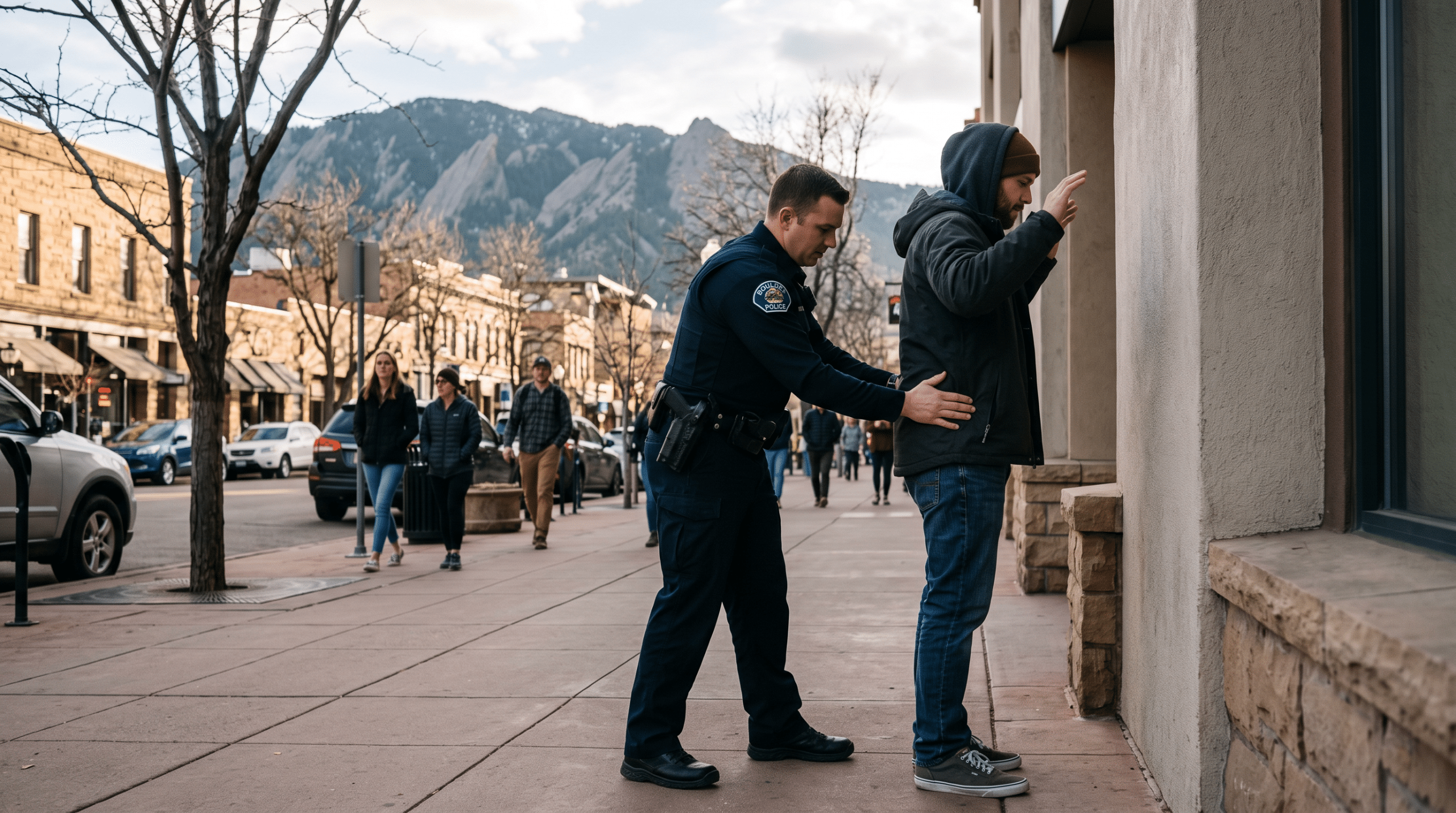
No, police are not allowed to frisk you every time they make a Terry stop. This is a key point to remember after any street stop, traffic stop, drug investigation, weapons allegation, or criminal arrest in Boulder. Even if an officer has a legal reason to stop and ask questions, that does not automatically give them the right to pat you down, go through your pockets, search your backpack, or look through your things. Colorado law sets a higher standard. We understand how upsetting it can feel when a short detention turns into a full search. At Watkins Law Firm LLC, we help clients in Boulder and the Denver area when illegal stops, frisks, searches, or seizures result in criminal charges.
What Is A Terry Stop?
A Terry stop comes from the United States Supreme Court case Terry v. Ohio. The term refers to a brief investigative detention based on reasonable suspicion, not full probable cause for arrest. In Colorado, C.R.S. § 16-3-103 addresses stopping a suspect. The statute allows a peace officer to stop a person in a public place when the officer reasonably suspects that the person is committing, has committed, or is about to commit a crime.
That authority has limits. The officer can ask for your name, address, identification if you have it, and an explanation of what you are doing. A Terry stop should not turn into a long investigation with no clear boundaries. The officer must have specific facts, not just a guess, a vague feeling, or simply because you are in a certain place.
A Stop Does Not Automatically Allow A Frisk
The frisk is a separate legal issue from the stop. Under C.R.S. § 16-3-103, an officer who has stopped a person may conduct a pat-down search for weapons only when the officer reasonably suspects that personal safety requires it. That means the officer must have a reason to believe the person may be armed and dangerous. The officer does not get to frisk every person simply because the officer initiated a stop.
This distinction matters in Colorado criminal defense. A stop may be lawful, but the frisk may still be unlawful. For example, an officer may have reasonable suspicion to briefly question someone about a reported trespass, shoplifting allegation, drug complaint, or disturbance. That does not automatically justify a pat-down. The officer needs additional facts showing a safety concern, such as a visible bulge, threatening movement, a credible weapons report, known violent conduct, or other specific circumstances.
What Police May And May Not Do During A Pat-Down
A lawful Terry frisk is supposed to be limited to a pat-down for weapons. It is not a general search for drugs, cash, identification, phones, pills, paraphernalia, or evidence of a crime. The purpose is officer safety. If an officer goes beyond that purpose, the search may become unconstitutional.
Police may pat the outside of clothing if the legal standard is met. They may remove an object if they reasonably believe it is a weapon. Problems arise when an officer manipulates a soft item, reaches into a pocket without a weapon-related reason, opens a container, searches a wallet, or uses the frisk as a shortcut to look for drugs. We look closely at body camera footage, officer reports, dispatch records, and witness statements to determine whether the search stayed within legal limits.
How A Frisk Can Lead To Criminal Charges
Many Colorado criminal cases begin with a pat-down. An officer may find a firearm, knife, pills, cocaine, methamphetamine, fentanyl, marijuana products, drug paraphernalia, stolen property, or other evidence. If the officer claims the item was found during a safety frisk, the prosecution may argue the search was lawful.
The resulting charge may depend on what was found. A concealed weapon allegation may involve C.R.S. § 18-12-105. A drug case may involve Colorado controlled substance statutes. A theft case may arise if property is allegedly stolen. A probation case may follow if the person was under court supervision. The key question is whether the officer had a lawful basis to frisk in the first place and whether the officer exceeded the permitted scope of the frisk.
Reasonable Suspicion Must Be Based On Facts
Reasonable suspicion is lower than probable cause, but it still requires objective facts. Courts do not have to accept vague phrases such as “furtive movements,” “high-crime area,” “nervous behavior,” or “officer safety” without examining what actually happened. Nervousness alone does not prove that someone is armed. Walking away does not always justify a frisk. Refusing consent does not create suspicion. Being near someone else who may have committed a crime does not automatically make a person searchable.
We challenge weak claims by asking direct questions. What did the officer see? What information came from dispatch? Was there a specific weapon report? Did the officer mention a safety concern before the search, or only later in the report? Did the person make threatening movements? Did body camera video support the officer’s written explanation? These details can decide whether the evidence should remain in the case.
When A Frisk Turns Into An Illegal Search
A frisk can become unlawful when it turns into a search for evidence. If an officer pats someone down and feels an object that is clearly not a weapon, the officer may not have the right to remove it. If the officer squeezes, slides, manipulates, or explores the item to determine whether it is drugs, the defense may argue the officer exceeded the lawful scope of the frisk.
This issue often comes up in drug cases. An officer may claim to feel a baggie, pipe, pill bottle, or small container during a pat-down. The defense may argue that the object did not feel like a weapon and that the officer used the pat-down to conduct a drug search without probable cause or a warrant. If the court agrees, the evidence may be suppressed.
Motions To Suppress Evidence In Colorado
When evidence comes from an unlawful stop, frisk, or search, we may file a motion to suppress. A suppression motion asks the judge to keep illegally obtained evidence out of the prosecution’s case. Colorado search warrant law is addressed in C.R.S. § 16-3-301, and admissibility issues may also involve C.R.S. § 16-3-308, Colorado constitutional protections, and the Fourth Amendment.
If the court suppresses the firearm, drugs, statements, or other evidence found during the frisk, the prosecution may have a much weaker case. In some situations, suppression can lead to a dismissal or a better negotiation posture. Even when suppression is not granted, the hearing may expose weaknesses in the officer’s testimony and help us prepare for trial.
What To Do If Police Try To Frisk You
If police stop you, stay calm and do not physically resist. You may ask whether you are free to leave. You may state that you do not consent to any search. You may ask for an attorney if questioning turns serious. You should not argue on the street, touch the officer, run, or reach suddenly toward pockets or bags.
The street is rarely the place to win the legal argument. The better place to fight is in court, with the video, reports, dispatch records, and officer testimony in front of a judge. If police found drugs, weapons, or other evidence during a frisk, do not assume the search was legal. The fact that police found something does not prove they had the right to search.
How We Defend Cases Involving Terry Stops And Frisks
At Watkins Law Firm LLC, we examine the stop and frisk step by step. We review whether the officer had reasonable suspicion for the stop, whether there were separate facts justifying a pat-down, whether the frisk was limited to weapons, and whether any evidence was found through an unlawful search. We compare the police report to body camera footage and dispatch audio. We also look at whether officers changed their reasoning after the fact.
These cases require careful legal analysis because one search issue may decide the entire case. If the evidence was found unlawfully, we fight to keep it out. If the officer’s explanation does not match the video, we use that. If police treated a limited stop like a full search, we challenge it.
Call Watkins Law Firm LLC For Help After A Colorado Stop Or Frisk
If police found drugs, weapons, stolen property, or other evidence during a Terry stop or pat-down, Watkins Law Firm LLC can help. We defend clients in Boulder and throughout the Denver area against drug charges, weapons charges, theft charges, assault allegations, DUI-related offenses, and other Colorado criminal cases. We know how to challenge unlawful stops, improper frisks, illegal searches, and evidence obtained in violation of your rights.
Contact our Boulder criminal law attorney by calling us 24/7 at 303-507-1324 for your free consultation. Our Boulder criminal defense lawyer represents clients in Boulder and throughout the Denver area from our office locations in Boulder, Colorado.
