
Can Body Camera Footage Help Your Colorado Criminal Defense Case?
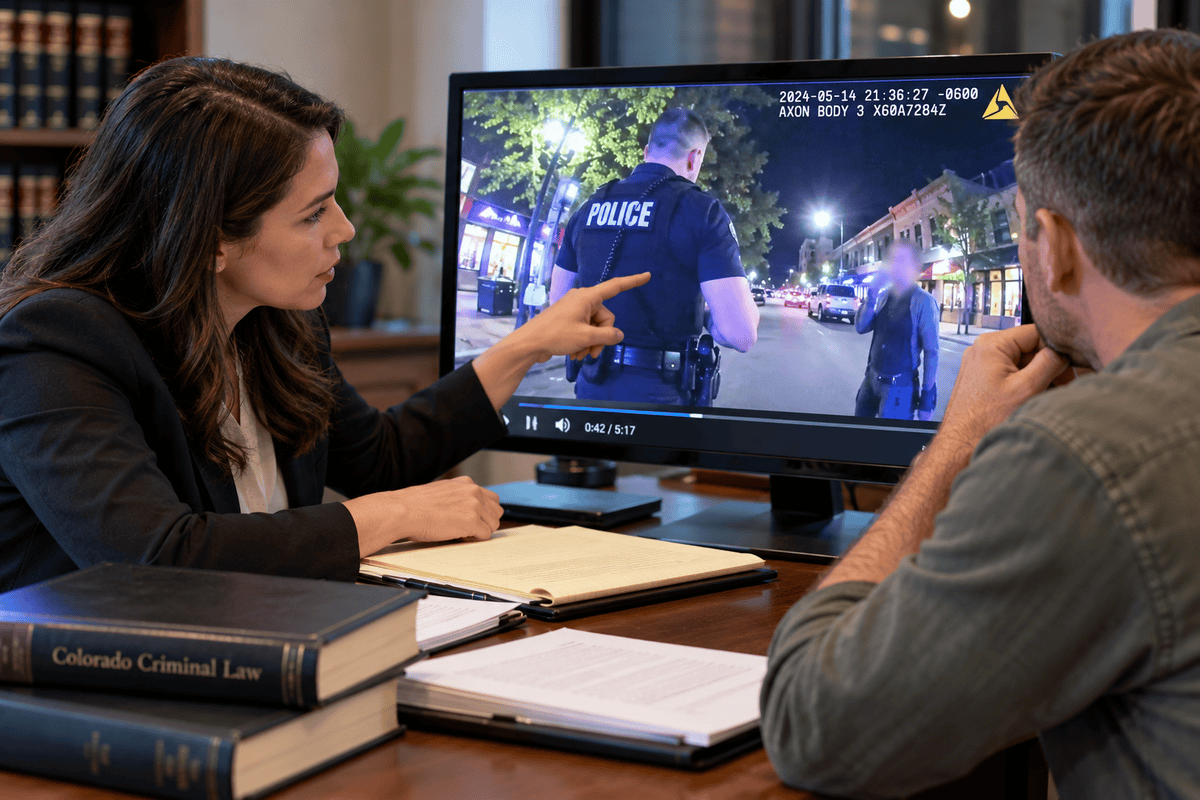
When we defend someone accused of a crime in Boulder, we know the police report may not tell the whole story. Body camera footage can show what really happened before, during, and after an arrest, often revealing details missing from an officer’s written account. The video might capture what the officer saw, what the accused said, how field sobriety tests were given, whether consent to search was requested, and how officers treated witnesses or suspects. It can also reveal differences between what was written later and what actually happened at the scene. That’s why we treat body camera footage as a key piece of evidence and review it closely whenever it’s available.
Colorado Law Requires Body Cameras During Many Police Encounters
Colorado has broad requirements governing police body-worn cameras. Under C.R.S. § 24-31-902, local law enforcement agencies and the Colorado State Patrol generally must provide body-worn cameras to officers who interact with members of the public.
The statute also requires officers to activate cameras in numerous circumstances, including when responding to calls for service, entering premises for law-enforcement purposes, conducting certain welfare checks, and participating in officer-initiated interactions with the public for purposes of enforcing or investigating possible violations of law. The statute contains specific exceptions and circumstances when recording may stop or is not required.
When we review a criminal case, we check if cameras were present, when they were turned on, if more than one officer recorded the event, and if any part of the incident was not captured.
Body Camera Footage Can Challenge the Police Report
A police report is the officer’s written version of what happened. Body camera footage, on the other hand, gives a real-time video and audio record from the scene. For example, an officer might claim our client was aggressive and ignored commands. But the video could show our client speaking calmly or reveal that the instructions were unclear. In another situation, an officer might say someone seemed very intoxicated, while the footage shows normal speech, balance, and behavior.
Body camera evidence does not automatically favor the defense. It can also support the prosecution. We therefore review the entire recording rather than focusing on a short clip. Context matters.
Body Camera Video May Help Us Challenge Searches and Seizures
Body camera footage can become especially important when we are evaluating the legality of a detention, search, or arrest. Colorado Rule of Criminal Procedure 41 permits a person harmed by an unlawful search and seizure to seek suppression of unlawfully obtained evidence. The rule identifies several potential grounds for suppression, including an illegal warrantless seizure, lack of probable cause supporting a warrant, or illegal execution of a warrant.
Video can help us pinpoint when a conversation turned into a detention. It might show what the officer knew before searching, whether permission to search was really given, or if officers went beyond what was allowed.
Those details can become central when we file a motion to suppress evidence.
Body Camera Footage Can Be Critical in DUI Cases
Colorado DUI investigations provide a good example of why video evidence matters. Police reports commonly describe observations such as bloodshot eyes, slurred speech, balance problems, difficulty following instructions, or poor performance on roadside tests.
We can compare those descriptions with the recording.
We may examine how clearly the officer explained roadside maneuvers, whether environmental conditions affected performance, how our client walked and spoke, and whether the video supports the officer’s description of impairment.
A camera cannot measure a driver’s blood alcohol concentration. It can, however, provide the court, prosecutor, and potentially a jury with evidence of the driver’s actual appearance and behavior.
What Happens When Required Body Camera Footage Is Missing?
Missing footage deserves careful investigation. C.R.S. § 24-31-902 contains consequences for failing to activate a required body-worn or dash camera and for tampering with footage. Colorado’s body-camera legislation was specifically designed to impose accountability when officers fail to record encounters that the law requires them to record.
We investigate why footage is missing rather than simply accepting that no recording exists. We may need to determine whether the officer activated the camera late, stopped recording prematurely, failed to activate it entirely, or whether another officer’s camera captured the missing portion.
We also look beyond body cameras. Dash-camera footage, dispatch records, 911 recordings, surveillance cameras, photographs, cellphone videos, and recordings from other responding officers may provide additional evidence.
Obtaining Body Camera Footage Through Criminal Discovery
Body camera evidence connected to a pending prosecution may also be addressed through Colorado’s criminal discovery process. Colorado Rule of Criminal Procedure 16 requires prosecutors to disclose categories of evidence within their possession or control, including police and offense reports, witness statements, photographs, tangible evidence, and certain recordings. Colorado courts also recognize that discoverable information can include relevant material held by investigative personnel and law enforcement agencies.
We want the complete available recordings whenever possible, not merely portions selected for use by the prosecution. Reviewing recordings from multiple officers can reveal different angles, conversations, observations, or events.
Body Camera Evidence Can Affect the Entire Defense Strategy
Video evidence can influence decisions long before trial. When footage contradicts an important prosecution allegation, we may use that evidence when challenging probable cause, litigating a suppression issue, negotiating with prosecutors, preparing cross-examination, or presenting the defense at trial.
At the same time, we never assume that a recording speaks for itself. Camera position, lighting, obstructions, background noise, missing portions, and limited viewing angles can affect what the recording actually establishes.
Our job is to place that footage within the larger evidentiary record and determine what it proves—and what it does not.
Frequently Asked Questions About Body Camera Footage in Colorado Criminal Cases
Can We Get the Police Body Camera Footage After an Arrest?
In a criminal prosecution, body camera recordings relevant to the case may be obtained through the discovery process. Colorado Rule of Criminal Procedure 16 governs prosecution disclosure obligations and includes several broad categories of case-related evidence. We examine discovery to identify recordings from every officer involved rather than assuming the first video provided represents the entire incident.
We may also look for dash-camera recordings, dispatch audio, photographs, surveillance footage, and other electronic evidence. Multiple recordings can be particularly valuable because one officer’s camera may capture something that another officer’s camera missed.
What If the Body Camera Footage Contradicts the Police Report?
We examine the discrepancy carefully. A meaningful contradiction can affect how we challenge an officer’s testimony or the prosecution’s theory of the case.
For example, a report might characterize someone’s behavior as aggressive, uncooperative, confused, or intoxicated. If the recording appears materially different, we can evaluate how that inconsistency affects the prosecution’s evidence. Not every difference is significant, however. We focus on discrepancies that relate to disputed facts, credibility, probable cause, elements of the charged offense, or a potential constitutional violation.
Can Body Camera Footage Get Criminal Evidence Suppressed?
Potentially, but the recording itself does not automatically cause suppression.
Instead, footage may provide evidence supporting a legal challenge. Colorado Rule of Criminal Procedure 41 allows us to seek suppression of evidence obtained through an unlawful search or seizure under qualifying circumstances.
For example, video might establish when police detained our client, what justification officers stated for a search, whether consent was requested, or how a warrant was executed. We can then compare those facts with constitutional requirements and Colorado law to determine whether a suppression motion is appropriate.
What If the Police Officer Did Not Turn On the Body Camera?
We first determine whether Colorado law required activation under the circumstances. C.R.S. § 24-31-902 generally requires activation during numerous calls for service and law-enforcement interactions with members of the public, although statutory exceptions apply.
If recording was required but did not occur, we investigate the reason and determine what legal consequences may follow. We also search for alternative recordings because another responding officer, patrol vehicle, nearby business, residence, or witness may have captured the incident.
Can Body Camera Footage Help Us Defend a Colorado DUI Charge?
Yes. DUI cases often depend heavily on an officer’s observations of a driver’s speech, balance, coordination, behavior, and performance during roadside testing. Body camera footage may allow us to independently examine those observations.
We can review the officer’s instructions, road or weather conditions, our client’s responses, movements, speech, and the overall sequence of the investigation. The recording may support some observations while undermining others. We evaluate the video together with chemical testing, police reports, witness evidence, and the circumstances surrounding the traffic stop.
Should We Review the Entire Recording or Just the Arrest?
We generally want to understand the entire relevant encounter. Events occurring before the physical arrest may be more important than the arrest itself.
The beginning of the recording can reveal why officers approached someone, what information they possessed, what questions they asked, and when they restricted the person’s freedom of movement. Later footage may capture statements, searches, witness conversations, or interactions between officers. Reviewing the sequence as a whole helps us determine whether important context has been omitted from a police report or prosecution narrative.
Call Our Boulder Criminal Law Lawyer For A Free Consultation
When body camera footage exists, we believe it deserves more than a quick viewing. We examine what happened before the arrest, compare the recordings with police reports and witness accounts, identify inconsistencies, and determine whether the footage raises constitutional or evidentiary issues that could affect the prosecution.
At Watkins Law Firm LLC, we defend people facing criminal charges in Boulder and throughout the Denver area from our office locations in Boulder, Colorado. If body camera footage may play a role in your case, we can evaluate the recording within the context of the evidence and determine how it may affect your defense.
If you have been arrested or charged with a crime in Colorado, we encourage you to have the evidence examined as early as possible. Body camera footage may provide important information about the stop, investigation, search, questioning, arrest, or conduct of the officers involved.
Contact our Boulder criminal defense attorney by calling us 24/7 at 303-507-1324 for your free consultation. We represent clients in Boulder and throughout the Denver area from our office locations in Boulder, Colorado.
