
Can I Seal My Criminal Record In Colorado? Eligibility, Waiting Periods, And The Record Sealing Process
A criminal record can affect someone long after their case ends. It might show up when applying for jobs, housing, licenses, school programs, loans, or volunteer work. In Boulder, sealing your record can limit who can see it, but whether you qualify depends on your case type, outcome, offense level, waiting period, and any later criminal history. Many people think a dismissed case just disappears, but that is not always true. We help clients find out what can be sealed, what might still be visible, and how sealing a record can help them move forward with fewer obstacles.
What Record Sealing Means In Colorado
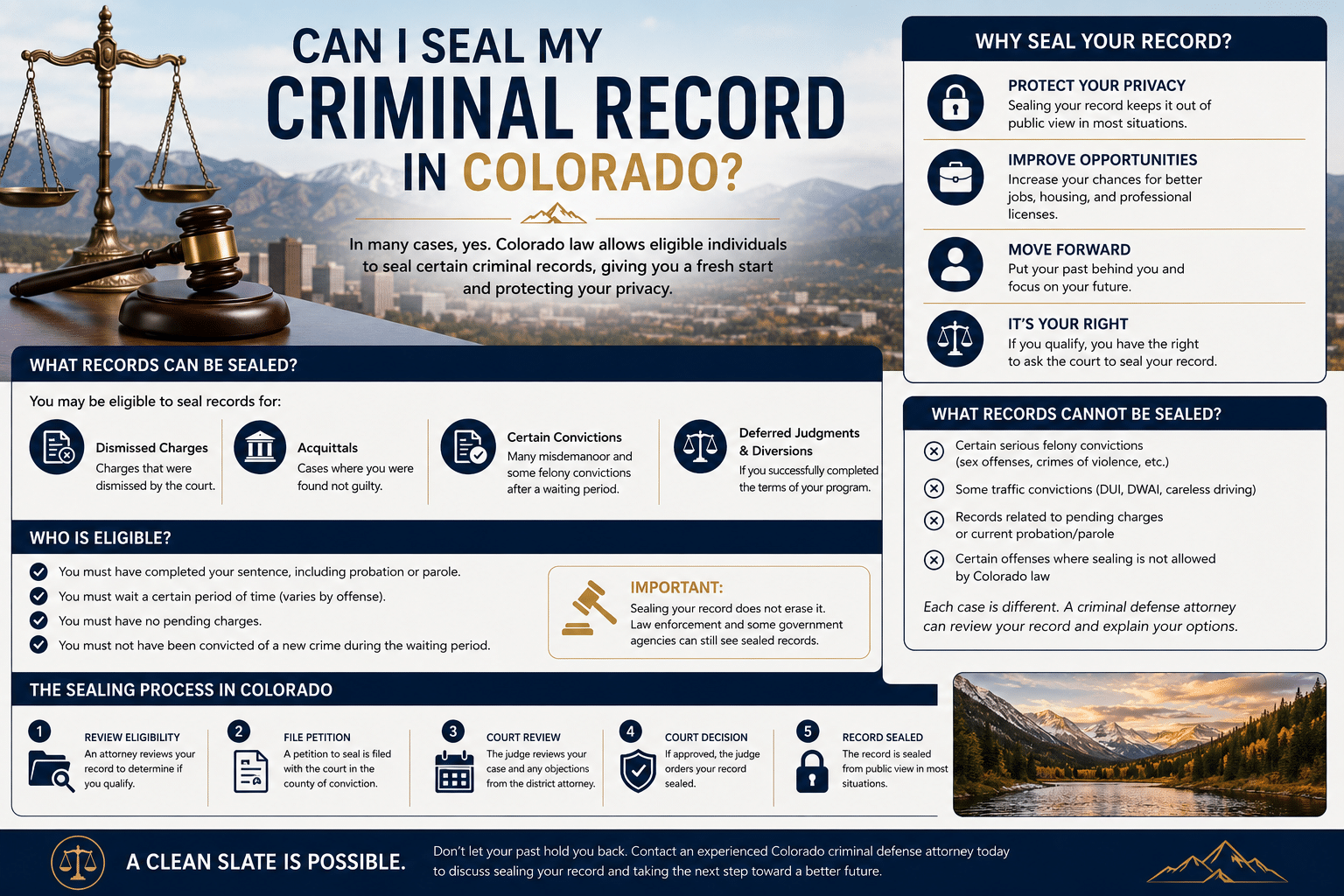
Sealing a record does not erase the past as some people might think. Instead, it usually limits who can see your criminal record. This can make a big difference when employers, landlords, schools, or background-check companies look up your history. Colorado law, under C.R.S. § 24-72-703, explains the general rules for sealing arrest and criminal records and states that sealed records are not available to the public like unsealed ones.
There are still important limits. Sealed records may remain available to courts, law enforcement, prosecutors, criminal justice agencies, and certain government or licensing entities that are legally required to conduct criminal history checks. This is why it is important to understand both the benefit and the limits of sealing. A sealed record can be powerful, but it is not the same as saying the event never happened for every purpose.
Sealing Arrest Records When No Charges Were Filed
Sometimes people are arrested but never charged. Colorado law, under C.R.S. § 24-72-704, covers sealing arrest records when no charges are filed. In some cases, arrest records may be sealed automatically once certain conditions are met. If this does not happen, you may need to take extra legal steps to ask for sealing.
This is important because an arrest record can still cause problems, even if there was no conviction. Someone may have done nothing wrong, or the government may not have had enough evidence. Still, the arrest can stay in databases unless it is sealed. We check if charges were filed, if the record was sealed automatically, and if a motion or petition is needed to fix the issue.
Sealing Dismissed Cases, Acquittals, And Deferred Judgments
Colorado law also lets people seal records other than convictions under C.R.S. § 24-72-705. This includes cases that were dismissed, ended in acquittal, or involved successful deferred judgments. Often, sealing can happen when the case is dismissed or acquitted. If not, you may need to file a written request.
A dismissed case can still cause problems if it is public. Employers might see the charge and make assumptions. Licensing boards may ask questions. Landlords could deny applications. Even if the case ended well, the record can still bring stress and embarrassment. Sealing can help reduce these problems and show you took the right legal steps after your case ended.
Deferred judgments require special attention. A deferred judgment may allow a person to avoid a conviction if all terms are completed successfully. However, not every deferred judgment is handled the same way, and some offenses may be excluded from sealing. We look closely at the original charge, the final disposition, the court record, and the statute that applies.
Sealing Criminal Convictions In Colorado
Sealing a conviction is usually harder than sealing a dismissed case. Colorado law, under C.R.S. § 24-72-706, covers sealing convictions. Whether you qualify depends on the type of offense, the waiting period, if you have been charged with or convicted of another crime during that time, and if your case is in a category that cannot be sealed.
Some petty offenses, misdemeanors, municipal offenses, and lower-level felonies may be eligible after the waiting period. Other convictions might not qualify or may need more proof. Serious offenses, violent crimes, sex offenses, or cases involving public safety are often treated differently. Colorado law has many categories and exceptions, so it is risky to guess eligibility just by the charge name. Some lower-level drug convictions may be sealable, while more serious felony drug convictions may have longer waiting periods or other barriers. A person’s full criminal history matters. If there are new charges or later convictions, the court may deny sealing or require additional time before the petition can be filed.
Colorado Waiting Periods For Record Sealing
Waiting periods are one of the most common points of Waiting periods often cause confusion. The right time to file depends on your case type and outcome. Some dismissed cases can be sealed right away. Some arrest records may be sealed automatically if no charges are filed. Some convictions require a waiting period after the case ends, supervision is finished, or all sentence terms are completed. If the offense was a petty offense, misdemeanor, drug misdemeanor, felony, or drug felony. The court may also consider whether all fines, costs, restitution, probation, treatment, and other terms have been completed. If restitution is unpaid, or if a person has a new pending case, the sealing request may face problems.
We often help clients by first determining the exact disposition date and sentence completion date. Those dates matter. Filing too early can waste time and money. Filing with incomplete information can lead to delay or denial.
The Colorado Record Sealing Process
The record sealing process usually starts with identifying the correct court, case number, charge, disposition, and statute. The required forms may vary depending on whether the person is trying to seal an arrest record, a dismissed case, a conviction, or another type of criminal justice record. The Colorado Judicial Branch provides sealing forms, but choosing the correct form and presenting the request properly can still be difficult.
A sealing request may require a motion or petition, service on the prosecutor, payment of filing or processing fees, and sometimes a hearing. The prosecution may object in certain cases. The judge may look at the person’s criminal history, the nature of the offense, the time that has passed, the need for public access, and whether sealing is allowed under the law.
If the court grants sealing, the order must be sent to the proper agencies. This may include the Colorado Bureau of Investigation and other custodians of the records. If agencies do not process the order correctly, the record may still appear in some places. We help clients address those follow-up issues so the sealing order has the intended effect.
Why Record Sealing Matters For Your Future
A criminal record can affect employment, housing, education, professional licensing, immigration issues, family responsibilities, and personal reputation. Even an old case can create new problems years later. Many people only learn this when they fail a background check or have to explain an old charge to an employer.
Sealing can help reduce public access to eligible records. It may allow a person to apply for jobs or housing with more confidence. It can also reduce the chance that an old case will keep coming up in daily life. For many clients, record sealing is not only a legal step. It is a practical step toward stability, privacy, and a better future.
Call Watkins Law Firm LLC For Help Sealing Your Colorado Criminal Record
If you are wondering whether you can seal your criminal record in Colorado, Watkins Law Firm LLC can help you understand your eligibility, waiting period, and next steps. We assist clients with record sealing issues involving dismissed cases, deferred judgments, drug cases, theft cases, DUI-related records, and other Colorado criminal matters. A record can continue to affect your life long after court is over, but you may have legal options to limit public access. Contact our Boulder criminal record attorney by calling us 24/7 at 303-507-1324 for your free consultation.
